
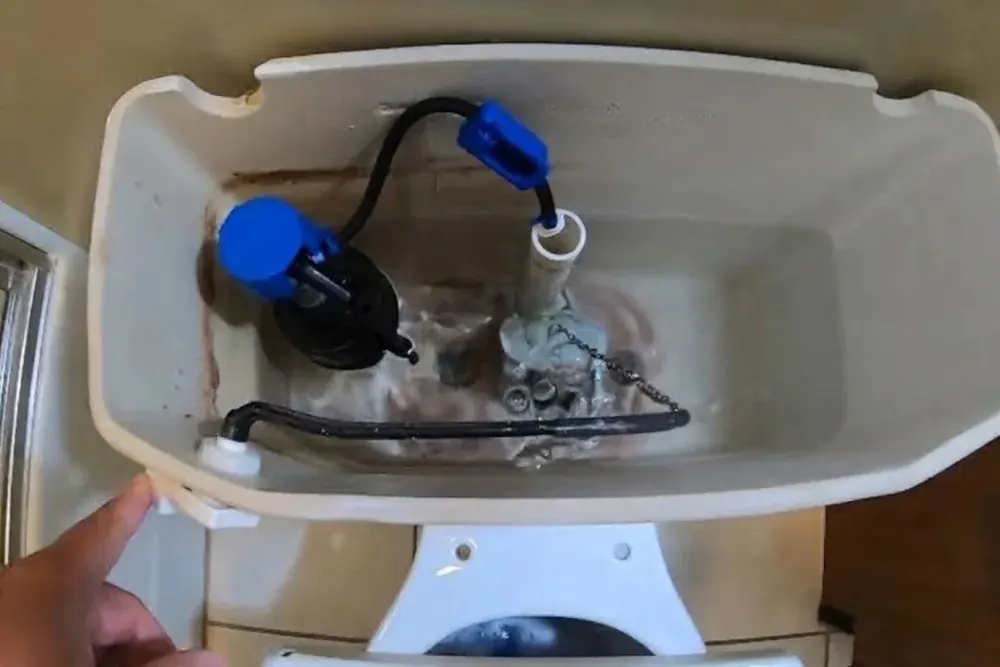
Toilet overflow: the first two minutes
Do not flush again. The water in a rising bowl comes from the tank, so the fastest fix is to stop the tank from emptying. Lift the lid, push the rubber flapper down, or lift the float so the fill valve shuts off.
Then find the stop valve on the wall or floor behind the toilet and turn it clockwise until it stops. That cuts the supply even if the float is stuck. Throw towels around the base, and call us once the water has stopped rising.
If the stop valve will not turn
An old valve can seize with mineral buildup. Do not force it with a wrench, because a broken stem makes things worse. Shut off the main water valve instead and tell the dispatcher what happened.
Three common toilet problems and what causes them
The toilet runs or hisses
A flapper that no longer seals, a fill valve that never shuts off, or a float set too high lets water slip into the overflow tube. A running toilet wastes water and often fixes cheaply, so do not ignore it.
The bowl clogs or flushes weakly
Paper and wipes are the usual cause. A weak flush with no clog can mean mineral-clogged rim jets or a partly blocked trap, and repeat clogs may point deeper into the drain line.
Water around the base
A failing wax ring, loose closet bolts or a rocking bowl let water out where the toilet meets the floor. A sweating tank can also drip, so check whether the water is clear and cold before assuming a seal failure.
Symptom, likely part and fix
| What you see | Likely part | Typical fix |
|---|---|---|
| Water trickles into the bowl on its own | Worn flapper or chain too tight | Replace the flapper, reset the chain |
| Tank refills constantly and hisses | Fill valve | Replace the fill valve and set the float |
| Handle needs a hold to flush | Loose or worn lift chain, handle arm | Adjust or replace the linkage |
| Puddle at the base after flushing | Wax ring or flange | Pull the toilet, replace the seal, reset it |
| Rocking bowl | Loose bolts or uneven floor | Tighten, shim or reset |
| Slow flush, gurgle | Clog or vent trouble | Auger the trap, see drain cleaning |
Repair or replace the toilet
Most running and leaking problems are parts, not porcelain. A tank full of 20-year-old fittings can often be rebuilt with a fill valve and flapper, and that takes a fraction of the time of a full replacement. A cracked bowl or tank, however, cannot be patched safely, and a toilet that has been repaired several times in a year is usually past saving.
Replacement is also worth discussing if the flush is weak, the fixture is far below modern efficiency, or the base is stained from old leaks. Modern toilets labeled WaterSense by the EPA are rated at 1.28 gallons per flush or less, and many clear the bowl better than older 3.5 gallon models.
What installation involves
The plumber shuts the supply, drains the tank and bowl, lifts the old toilet and scrapes the flange clean. A new wax ring or seal goes in, the toilet is set level, bolted down and connected to a fresh supply line. Rough-in distance, the gap from the wall to the center of the flange, decides which models fit. The standard distance is 12 inches, though older homes can differ, so measure before you shop.
Toilet down and no second bathroom
Call the 24/7 line. Tell the dispatcher whether it is leaking, running or clogged.
What Easton homes tend to run into
Older homes near the village centers can have uneven floors, soft subfloor around the toilet flange, and old cast iron or galvanized drains that clog easily. A toilet that leaks for a long time can rot the floor underneath, so a puddle near the base deserves quick attention even if it looks small. The plumber will check the floor for softness while the toilet is off.
Whether you are on town sewer or a private septic system also matters. On septic, wipes labeled flushable and heavy chemical bowl cleaners hurt the tank over time. On either system, repeat clogs across several fixtures suggest a main-line issue, which is a job for sewer line cleaning.
How the repair visit goes
Stop the water
The plumber shuts off the stop valve and checks it still seals.
Diagnose the cause
Tank parts, the bowl seal and the drain are tested in order, so you pay for the real fault.
Repair or reset
Parts are replaced, or the toilet is lifted and reset on a new seal.
Test several flushes
The plumber checks for leaks at the base, the supply line and the tank bolts.
Clean up
The old fittings are taken away and the floor is left dry.
What affects the cost of toilet repair
You get a clear price before work starts. These factors shape it.
What moves the price
If a leak has soaked the floor below, photograph it and ask your insurer what it covers before repairs.
☎ Want your real number? Call (508) 389-4045Toilet repair questions from Easton homeowners
Yes. The line is answered at all hours, including weekends and holidays. Tell us whether the toilet is overflowing, leaking or just running.
Not for long. Even a slow leak can soak the subfloor, and a toilet that rocks can break its seal. Shut the stop valve until it is fixed.
Clearing a stoppage is exempt under the state plumbing code, but replacing a fixture can fall under permit rules. Ask us or the Easton building department about the job in front of you.
That is usually a leaking flapper that lets tank water seep into the bowl. The fill valve then tops it up. Replacing the flapper normally fixes it.
Sometimes, but repeat clogs in more than one fixture point to the drain. Our hydro jetting page covers lines that need more than a cable.