
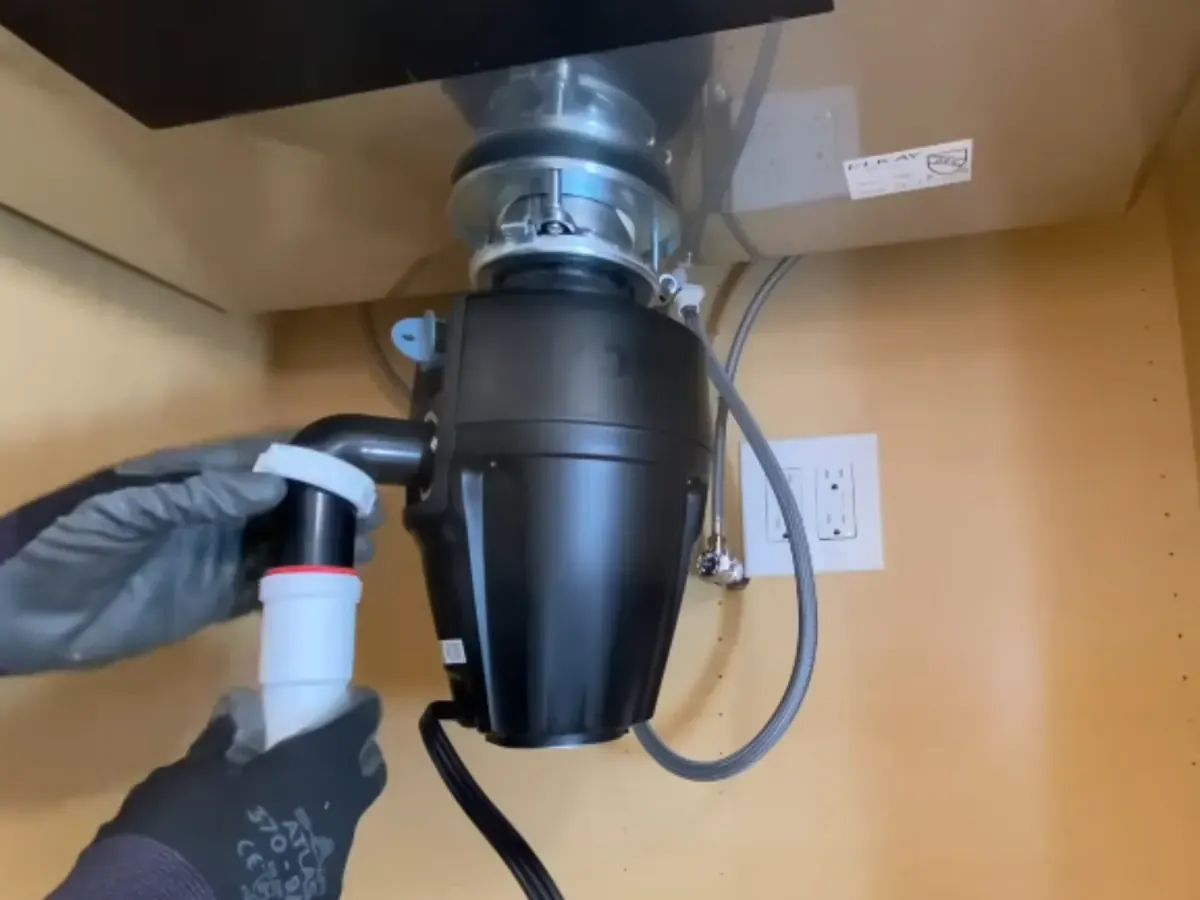
The short answer: what to do with a dead or humming disposal
If the disposal hums but the blades will not turn, it is jammed. Turn the wall switch off, unplug the unit or shut off its breaker, then work the blades loose with the hex key socket at the bottom or a wooden spoon handle from the top. Press the red reset button on the underside once the blades spin freely.
If there is no sound at all, the reset button has probably tripped or the outlet has lost power. Check both before you assume the motor is dead. A leak, a burning smell or a motor that trips again right away means stop and call a plumber.
Symptom, likely cause and your first move
Match what you hear and see to the table below. The first move in every row is something you can do without taking the unit apart.
| What you notice | Likely cause | First move |
|---|---|---|
| Loud hum, blades will not spin | Jam from a bone, fruit pit or utensil | Power off, turn the blades by hand with the hex key |
| No sound, no hum | Tripped reset or dead outlet | Press the reset button, then test the outlet |
| Water under the sink | Loose drain flange, hose clamp or a cracked housing | Dry everything, run water and find where it first appears |
| Sink drains slowly with the unit running | Clog past the disposal in the trap or branch line | See drain cleaning if the sink stays slow |
| Grinding and rattling | A loose object or worn grinding parts | Power off, look inside with a flashlight and tongs |
| Bad smell | Food film on the chamber walls | Flush with cold water and citrus peel, no harsh chemicals |
How to clear a jam and reset the unit
This is the one repair most homeowners can do safely, as long as the power is truly off. Never put a hand into the chamber, even when the switch is off.
Cut the power
Switch off the wall control, then unplug the disposal under the sink or turn off its breaker. A switch alone is not enough, because another person can flip it.
Look inside with a light
Use a flashlight and long tongs to remove anything you can see, such as a bottle cap, a fruit pit or a piece of bone.
Turn the blades by hand
Fit the hex key into the socket in the center of the underside and work it back and forth until it turns a full circle. A wooden spoon handle pressed against a blade from above does the same job.
Press the reset
The small red button on the underside pops out when the motor overheats. Push it in and wait a minute.
Test with water
Run a strong stream of cold water, restore power and switch the unit on for a few seconds. If it hums again or the reset trips, stop.
Leaks: where the water is really coming from
A wet cabinet floor is the second most common reason for a call. The water can come from three places: the sink flange at the top where the disposal hangs from the sink, the dishwasher hose that connects to a side port, or the drain elbow and trap leaving the unit. Dry every part with a towel, run water, then watch with a flashlight to see where the first drop appears.
A drip from the flange or a loose hose clamp is often a tightening or a fresh seal. Water seeping from the body of the unit itself means the housing has corroded or cracked, and no gasket fixes that. At that point the unit needs replacing, and a plumber can size it to the horsepower your household actually needs. Our garbage disposal repair page lists how those visits work.
Fix it yourself or call a plumber
There is no shame in stopping early. A disposal sits under a wet sink, wired to household power, and a wrong move costs more than a visit.
Reasonable to try at home
- Resetting a tripped overload button
- Freeing a jam with a hex key after cutting power
- Tightening a loose drain elbow or hose clamp
- Cleaning the chamber and the splash guard
- Running cold water and ice to knock off residue
Call a licensed plumber
- Water coming from the body of the unit
- A reset that trips again within minutes
- Burning smell, smoke or sparks
- A hum with a jam that the hex key cannot move
- Any unit that will not drain even with the blades free
- Wiring that looks damaged or a missing plug
Replacing a disposal involves electrical and drain connections, and a trained plumber makes both without leaving a slow leak behind. If the whole sink is slow, the problem is often the pipe beyond the unit and not the disposal at all.
On septic in Easton? Your disposal matters more
Parts of Easton are on town sewer and parts use private septic, and a disposal puts a heavier load on a septic tank. Food scraps add solids and grease, and the tank fills with sludge and scum faster as a result.
MassDEP's consumer guidance on septic systems advises pumping the tank every three years, and every year if you use a garbage disposal. If you are not sure which system serves your house, ask the Easton Board of Health or look for a cleanout and a tank lid in the yard.
Source type: MassDEP and Mass.gov consumer guidance on septic system inspections, pumping and repairs
What never to put down a disposal
Most repair calls start with something that should have gone in the trash. A short list, kept near the sink, prevents most of them.
Keep these out of the disposal
- Grease, fat and oil, which cool and coat the drain pipe beyond the unit
- Coffee grounds in large amounts, because they pack into a paste
- Pasta, rice and bread, which swell with water
- Potato peels, celery and corn husks, whose fibers wrap the blades
- Bones, fruit pits and shells that are too hard for the grinding parts
- Glass, metal, plastic wrap and twist ties
- Chemical drain openers, which sit in a standing trap and attack seals
- Anything you would not want to meet on the way to a septic tank
Run cold water before, during and for about fifteen seconds after each use. Cold water keeps fats solid so the blades can chop them and the water flushes them down the line.
Local reasons a disposal fails in an older Easton kitchen
Many kitchens in older Easton homes were remodeled around a drain that dates back decades. The branch line under the sink may be galvanized steel or old cast iron, and scale on those walls snags scraps from a disposal. The disposal itself runs fine and the pipe beyond it clogs, which people mistake for a bad unit.
Newer homes have the opposite problem. They have smooth PVC and a bigger disposal, so people treat the unit like an incinerator. A powerful motor does not change the fact that the drain beyond it carries the same flow as a small sink. When both the disposal and the line are suspect, a plumber can check each with one visit.
Costs and when replacement beats repair
No two disposal jobs cost the same, and anyone quoting a number over the phone without seeing the unit is guessing. The factors are the age of the unit, whether the leak is at a seal or in the housing, the horsepower you want, and whether the wiring and mounting need work. Time of day also matters, since nights and holidays are emergency visits.
As a rule, a unit that leaks from the body, or one that has needed a reset every week, is near the end of its life. A loose flange or a hose clamp is a repair. A plumber should tell you which it is before starting, and give a clear price before work begins. Where a kitchen leak hides inside a wall or the floor, leak detection finds the source without opening more than needed.
Where we help around Easton
Dispatch covers Easton and nearby towns, so a jammed disposal in Mansfield or a leak under a sink in Stoughton gets the same answer as one in North Easton. Calls to the line are answered around the clock, because a flooded cabinet does not wait for business hours.
Septic guidance for disposal users
According to MassDEP's septic guidance, a household that uses a disposal puts more solids into the tank and should pump it more often. Always follow the manufacturer's guidelines in your manual before any reset.
Disposal questions from Easton homeowners
Yes, but expect to pump the tank more often. MassDEP's guidance says to pump every year when a disposal is in use, against every three years without one.
The motor has power but a jam is holding the blades. Cut the power, free the blades with the hex key, then press the reset and test.
It is often just the hose clamp or the knockout plug that was never removed. Check the port on the side of the unit before you blame the housing.
Cold water is better. Hot water melts fats so they slip past the blades and settle farther down the line.
Massachusetts exempts repairing a leak in a faucet or valve and clearing a stoppage. Replacing fixtures can fall under permit rules, so ask the Easton building department or let the plumber confirm.
Then the blockage is probably past the unit. Stop sending food down it and call for a cable or jet to clear the trap and branch line.