
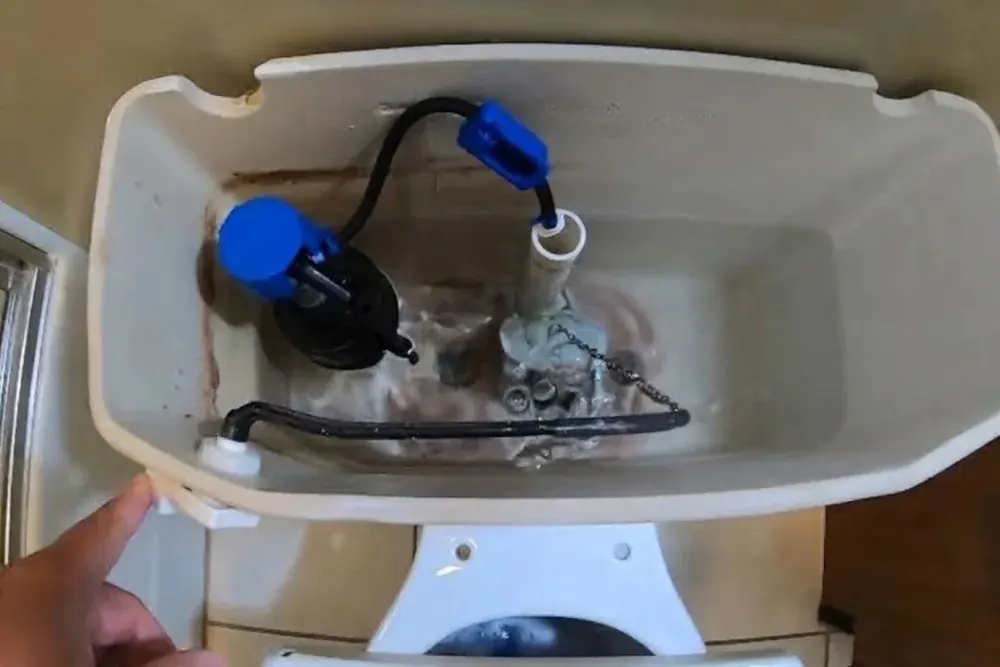
Start here: three toilet problems, three answers
If the tank keeps refilling or you hear a trickle after the flush, replace the flapper first, and check the fill valve if that does not help. If the bowl rocks or water seeps around the base, the wax ring is failing and the toilet has to come up. If water sprays or the toilet overflows, shut the supply valve and call a plumber.
That sorting covers most toilet trouble in Easton houses. The first group is plain homeowner work with simple tools. The second is doable if you can lift about the weight of a bag of cement. The third is a stop sign.
Match the symptom to the part
Tank refills on its own
Water slips past a worn flapper into the bowl, so the fill valve keeps topping up. The ghost flush every few minutes is the giveaway.
Weak or slow flush
Low water in the tank, a chain with too much slack, or mineral buildup in the rim holes. These are cheap to check before you blame the drain.
Water at the base
A failed wax ring or loose closet bolts. Sometimes it is only a supply connection or tank condensation, so dry everything and watch where the first drop forms.
DIY or call a plumber
| Repair | Skill level | Verdict |
|---|---|---|
| Replace a worn flapper or adjust the chain | Beginner | DIY, shut the supply first |
| Replace the fill valve or float | Beginner to moderate | DIY if the shutoff valve works |
| Replace the supply line | Beginner | DIY, use a braided line and hand-tighten plus a quarter turn |
| Replace the wax ring | Moderate | DIY if you can lift the toilet, otherwise call for toilet repair |
| Clear a clog with a plunger or closet auger | Beginner | DIY, but see the notes on repeated clogs below |
| Replace a cracked bowl or tank | Moderate to hard | Call a licensed plumber |
| Repair a leaking shutoff valve in the wall | Hard | Call a plumber, the valve is part of the house supply |
Replacing a flapper, step by step
This is the most common fix and the best one to try first.
Test for the leak
Add a few drops of food coloring to the tank, wait without flushing, and look for color in the bowl. If it shows up, the flapper or flush valve seal is leaking.
Shut off and drain
Close the supply valve at the wall, flush, and hold the handle so the tank empties as far as it will.
Remove the old flapper
Unhook it from the pegs on the overflow tube and lift off the chain. Take the old one to the store or photograph it so you buy a match.
Fit the new flapper
Clip it onto the pegs and connect the chain with a little slack, about a link or two, so it seats fully.
Restore water and retest
Open the valve, let the tank fill and repeat the dye test after ten minutes. Clean color in the tank means you are done.
Fill valve and flush quality
If the water level keeps rising or the tank hisses all day, the fill valve may be worn or set too high. Modern fill valves adjust their height with a twist, so replacing one takes about as long as the flapper.
To swap one, turn the water off, disconnect the supply and loosen the locknut under the tank. Fit the new valve and set the water line about an inch below the top of the overflow tube.
For a weak flush, look at the rim holes under the bowl lip. Mineral crust can narrow them. If you see crusty deposits, a small mirror and a stiff brush will clear most of it, or use a descaling product made for toilets. Check your town's annual water quality report if you are curious about what is in the supply.
Wax rings, rocking bowls and the weight problem
A wax ring seals the toilet outlet to the drain flange. Once it fails, the base leaks and the floor underneath can soften before you notice. Before you buy a ring, check that the flange sits level with the finished floor and that the closet bolts are tight but not cranked.
Replacing the ring means shutting off the water, emptying the tank and bowl, disconnecting the supply, and lifting the toilet straight up. A porcelain toilet is heavy and the edges are sharp, so get a helper. If the floor around the flange is soft, stop. That is a subfloor repair, and in older Easton houses it is not unusual to find rot under a long-term leak.
Fix that running toilet: what the EPA says about leak testing
The EPA's WaterSense program recommends the same dye test described above. Add food coloring to the tank, wait without flushing, and if color reaches the bowl, the flapper or flush valve is leaking and should be replaced. Leaks are one of the quietest ways a household loses water.
Easton homes get their water from the Easton Water Division, so a running toilet shows up first on your own water bill and meter reading. If the meter keeps moving with every fixture off, the leak may be elsewhere, and leak detection is the next step.
Source type: EPA WaterSense, Fix a Leak guidance
Before you start any toilet repair
A small amount of setup prevents most of the mistakes.
Toilet repair prep
- Locate the shutoff valve behind the toilet and confirm it closes fully.
- Put down towels and a bucket, and keep a sponge handy for the tank.
- Photograph the old part before you remove it and note any model number.
- Wear gloves and eye protection, and keep the bathroom ventilated.
- Buy a few spare parts (flapper, supply line, extra bolts) so one trip is enough.
- Plan on the bathroom being unusable for an hour, or longer for a wax ring.
- Know where the main water shutoff is in case the wall valve fails.
When to stop and call
Call a licensed plumber if the shutoff valve will not close or drips when you turn it, if the toilet clogs again and again, or if water shows up in the ceiling below. Repeated clogs point past the bowl to the drain line, and our drain cleaning team can clear and inspect it.
In Massachusetts, repairing a leak in a faucet or valve and clearing a stoppage are exempt from the permit rule, but altering pipes is not. Ask the Easton building department before swapping anything in the wall.
We serve Stoughton, Sharon and Brockton as well as Easton, with a clear price before work starts. If a homeowner repair has gone sideways, call anyway. It is better to say so than to leave water running behind a wall.
What the plumbing code says
Clearing a stoppage and repairing a valve leak are exempt from permits under 248 CMR 3.05, according to the state plumbing code. Follow the manufacturer's guidelines for your toilet model when you buy parts.
Toilet repair questions from Easton homeowners
It is common. Rubber flappers harden over the years, and a toilet from an older house may use a style of flush valve that is hard to match. Bring the old part to a hardware store.
Swapping a toilet for another is something many homeowners do, but plumbing code treats altered plumbing as permitted work. Confirm with the Easton building department first.
Usually no. It points to a partial blockage in the main drain or vent. If your house is on septic, the tank or field could also be involved.
Cold water in the tank meets warm humid air and condensation forms. A ventilated bathroom helps, and an insulated tank liner is a cheap fix. If the base stays dry, it is not a leak.
Skip them. Chlorine tablets in the tank can eat the flapper and fill valve gaskets and shorten their life.
Press on the floor beside the toilet. A spongy feel, a dark stain or a musty smell means moisture has been there for a while and a plumber should look at it.